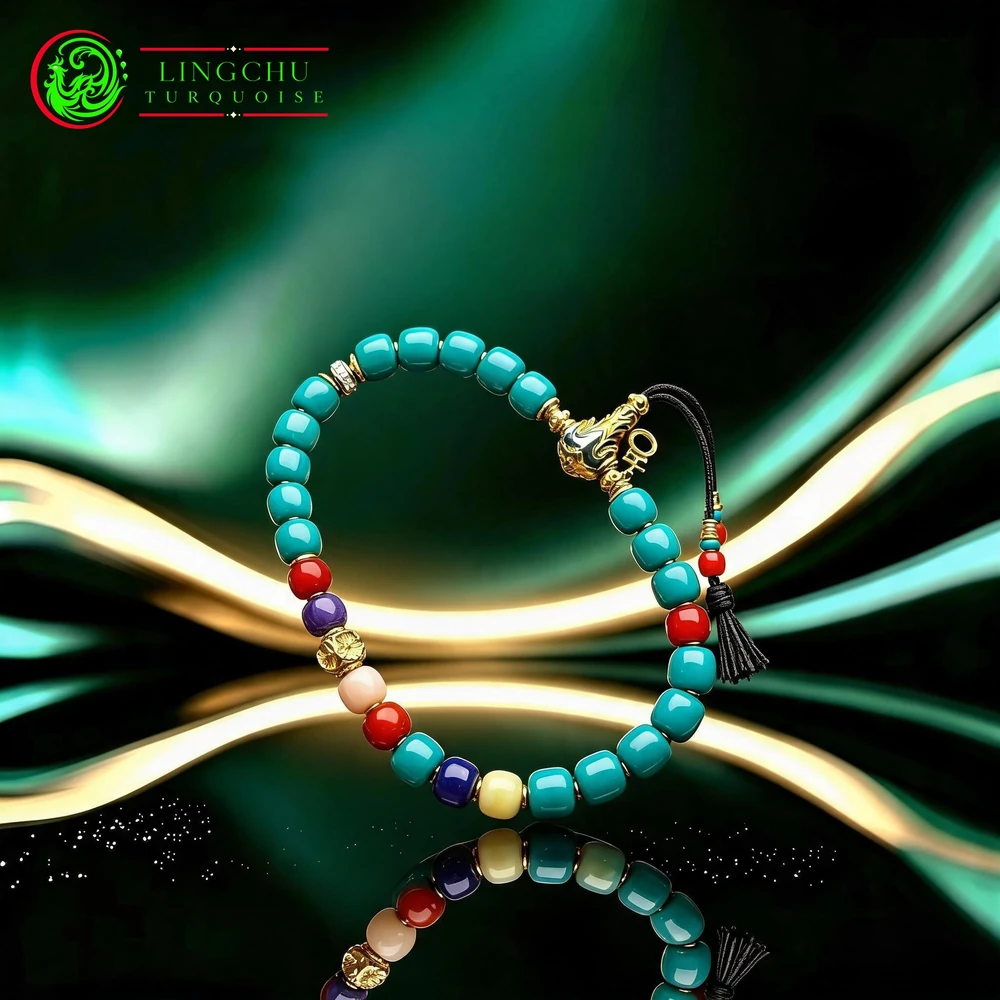
Complete guru bead, spacer, counter, and tassel component sets — color-matched and batch-coordinated in Zhushan, Hubei for mala makers, spiritual brands, and jewelry designers.
LingChu supplies complete turquoise mala component sets from Zhushan, Hubei — the historic center of Chinese turquoise production. Each set is coordinated around a consistent color range, matrix pattern, and material character, so mala makers, spiritual product brands, and jewelry designers receive all matching parts in one order rather than hunting across multiple suppliers.
A standard mala component set from LingChu includes the guru bead (the large center or terminal bead), spacer beads, counter beads for tracking mantra recitations, and tassel accessories. Every piece is cut from material selected to work together visually and physically. We do not assemble finished malas; we provide the components that makers use to build them.
Spiritual product brands, mala makers and teachers, jewelry designers, gift product buyers, and wholesale buyers order component sets to reduce assembly time and ensure visual consistency across finished pieces.
Four coordinated component groups, cut from material selected to work together.
The focal bead of the mala, traditionally a three-hole design that anchors the tassel and marks the start/end point of the strand. We produce guru beads in round, barrel, and carved forms — including traditional Chinese motifs such as Guanyin and Maitreya. Sizes typically range from 12 mm to 20 mm.
Small beads that separate the larger main beads and create visual rhythm. Available as plain rounds, heishi discs, rondelles, and carved miniatures. Spacer diameter usually runs 4 mm to 8 mm, with hole sizes matched to the cord or wire you plan to use.
Smaller accent beads — often in sets of 10 — that sit above the guru bead for counting during meditation practice. We supply these as matching mini-beads or as small carved forms such as lotus, cloud, or simple round shapes.
Tassel caps and end pieces that finish the mala — plain turquoise caps, metal caps with turquoise inlay, or carved end pieces.
Density and hardness matter most for guru beads and carved components — these pieces receive the most handling and are often the focal point of the finished mala. Higher-density material holds fine carving detail and resists surface wear; for counter beads and spacers that see less direct contact, a broader density range is acceptable.
Matrix pattern should read as a family across the set. A spiderweb guru bead paired with clean spacers and a landscape-matrix tassel cap can look disjointed. We select material lots specifically for set coordination and offer batch matching for repeat orders.
Treatment status should be uniform within a set — mixing natural and stabilized turquoise in the same mala can lead to uneven aging and color shift over time. We disclose treatment status for every component group and recommend matching treatment levels within each set.
From full 108-bead malas to designer jewelry applications.
For a full 108-bead mala with 8 mm main beads: 1 guru bead (14–16 mm), 108 spacer beads (4–5 mm, optional depending on design), 10 counter beads (6–8 mm), and 1 tassel cap with end piece.
For smaller wrist malas: 1 guru bead (10–12 mm), 4–6 spacer beads, 4 counter beads, and an optional mini-tassel or cord end piece.
For non-mala jewelry using mala-style components: 1 feature guru bead as pendant focal, spacer and counter beads for necklace or bracelet accents, and cord end caps instead of a tassel.
Individual components and matching main-strand beads for your mala program.
Send your main bead reference — color, size, matrix, and treatment status — and receive a sample set to review color matching, hole alignment, and overall balance before production.